
As I looked out the airplane window the snow-capped mountains touched the sky. A broad bay licked mud flats blending to salt marshes then to verdant muskegs, all laced with watery tendrils bisected by a slate blue river. I spotted a glacier deep in a mountain pass. Our flight path would take us closer. This was the Alaska of my father’s reminiscence. I had arrived.
The pilot’s voice drifted through my trance, “We’ll be landing over there.”
I craned my neck. Perhaps Anchorage was ahead and not yet in view though the plane banked and began a slow circle illuminating the glacier in sharper relief.
More distinctly I heard, “I have not landed here in years.”
What did he mean “…not landed here in years?” Doesn’t he fly this route all the time? I looked harder for signs a runway, or anything approaching civilization. My watch indicated we had at least an hour left. What was going on?
“Yep! That should do,” came his announcement and with that the plane powered back and we began a frightening descent into the abyss.
We hit the ground and bounced, then settled down and rumbled over rough gravel. Behind us the plane’s tail shimmied side-to-side. Then we were stopped.
“That was a terrible landing, just terrible!” the pilot quipped.
We were alive. That made it a good landing. Any landing from which you walk away is a good landing.
I extracted myself and walked weak-kneed through the scrub. On a small knoll I spun a gawkish pirouette. In the middle distance the Knik Glacier rose above a narrow lake. An icy blue archipelago floated before it.
I turned again and looked upon the aircraft from which I had emerged, a gold and white two-seat bush plane. The pilot, Bill Quirk, busied himself near the doorway looking for his camera to take with us on a hike to the ice field.
To say Bill is enthusiastic about bush flying would be an understatement. As a young boy growing up in south central Louisiana he caught the flying bug after a helicopter ride with a local pilot. Though his aviation aspirations were stifled by his family, his interest remained and finally in his mid-thirties he joined an Army flying club near Anchorage, Alaska where he worked as a natural resources manager for the Department of Defense. He soloed in 1976 and has since amassed several thousand flying hours and written two books on Alaska bush piloting. It was through Bill’s work as a federal land manager that he met my stepmother, who in turn tracked him down for me.
We walked through the scattered brush down a winding descent to the water’s edge. The icebergs drifting in the light gray water looked much larger now than they had flying over them. Some had smooth pale white contours while others rose in jagged, blue spikes. Bill lamented that the glacier was now only half the size it was a few decades ago. The glaciers in the Alaska Pacific Range are melting, and I could see it both here at Knik and on my airline flight in along the coast where tall, dark ledges surrounding the flows marked where ice had once been. Bill considers he has lived during the “golden age” of bush flying in Alaska before the melt when he could do winter ski-landings just about anywhere.
We returned to the aircraft and with an equally bumpy take off the plane, an Arctic Tern, leapt into the air. We turned northwest out of the pass, the Chugach mountains rising sharply to our left and Lazy Mountain towering over Butte and Palmer to the north. Beneath us, the chalky-blue Knik River meandered along the base of the mountains. Scattered ponds and creeks separated by lemon lime colored grasses filled the remaining expanse as far as the eye could see. Bill shot another landing on a gravel bar though rather than exiting he offered, "Let me take take you to a better place." Up we went again.
Our third landing did not disappoint. We put down on a broad gravel bar in the middle of the Knik River. The Glenn Highway Knik River Bridge was visible immediately to our east leading to Butte. As we walked Bill pointed to a tall Chugach peak and recounted an arduous hike to its summit years ago, “I couldn’t do that now. I’m too old.”
"You want to see some moose," he blurted as we walked back to the plane.
"Well, sure." I half expected he would snap his fingers and bulls would appear though it did not take much more than that.
Part of Bill's role as a natural resources manager was to conduct aerial wildlife surveys. In his book he recounts detailed surveys of moose, Dall sheep, bald eagles, bear, trumpeter swans, and even beluga whales though they proved elusive. Now retired he still enthusiastically tracks swans and moose.
 Within minutes of flight over the muskeg
he banked the plane sharply to the right and pointed, “See the cow
moose and her calf?” I did. We proceeded to do a number of sixty degree
figure-eight turns all the while spotting more moose and swans. My
stomach was reeling.
Soon we pointed straight west then southwest toward Anchorage while Bill recounted his favorite flying exploits over the headset. We settled down for a smooth landing on the gravel runway at Merrill field, and the tower controller chatted with Bill about the swans.
Once out of the plane Bill was eager to continue his narrative, but my time was short and I was eager to see more of Alaska in the few hours before my trip home. I gave Bill a heartfelt thanks, jumped in my rental car, and rolled off the tarmac.
Our farm in Virginia affords an expansive westward view of the Shenandoah Mountains and Skyline Drive. We have grown accustomed to watching thunderstorms billow over the mountains and roll eastward toward us. Some pass without a raindrop while others bring heavy showers. This evening everything was different.
My wife and her parents arrived for a double-celebration weekend - our 21st wedding anniversary and her father’s 75th birthday, both June 29. My son joined us for dinner but opted to drive home to Maryland afterward rather than stay the night. As we bid him a good evening we looked west and saw not billowing clouds, but a solid black veil across the horizon rapidly cresting over us.
The sky ignited in continuous lightning and the veil enveloped us. Then we heard the wind. It approached like a cresting wave and slammed into the house so hard the windows shook. In the darkness the air was so thick it was hard to breathe. We dashed inside and it continued to build. The power went dead. As I watched the buckeye tree beside the house thrash like bamboo and the glass doors billow, we decided to head for the basement. Jeanne, her parents and I conversed by flashlight, but we could not take our attention from the raging cacophony outside.
After a while I ventured upstairs. As I approached the window rivulets of water streamed on my head. I wondered, “How could it be raining inside?” My flashlight revealed several steady leaks falling from the ceiling. I assumed a pipe had burst, but looking upstairs I could find no evidence of broken plumbing. I stepped back and looked at the walls in disbelief. The horizontal torrents lashing the house were driving through every log crevice and beam forming pools on the floor and causing the “indoor rain” below. Alas, entire beams were saturated.
It was not a “quick” storm. It slowly receded over a few hours and we managed a fitful night of sleep with no power, no water, and no news from the outside world.
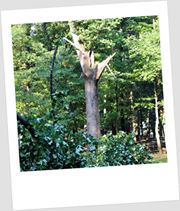
The morning light revealed wrecks of trees across the field and driveway - a seventy foot poplar snapped in half; a similar sized maple completely uprooted. In all we counted seven full grown trees fallen. Branches covered the field like confetti. A large glass terrarium had blown off the porch and shattered. Our gas grill and wooden Adirondack chair had toppled across the lawn.
It was an anniversary we will never forget. Little did we know this would turn out to be the great Derecho of 2012.

Over thousands of miles and hundreds of flights my air travel has blurred to a single amalgam. I no longer recall individual airports or trips though occasionally a single airplane ride etches itself indelibly in my memory – sometimes for the drama, sometimes for just an epiphany.
This morning I departed for San Antonio. The air was crystal clear as only a February morning can give. The flight path took us west, and I was amazed how clearly I could make out my very own house below. We then turned gently south, and just as clearly I could see the Potomac River meander from Harpers Ferry through Point of Rocks and past Leesburg – all in a single view. Further on lay Thoroughfare Gap, The Plains, Warrenton, and then Culpeper. My heart warmed to see Old Rag Mountain and then our Novum farm. I had the urge to knock on the cockpit door and say, “You can drop me off here, please.” We continued to traverse the Route 29 corridor until I saw Roanoke and finally the New River leading to Blacksburg.
In a mere thirty minutes I had traced the arc of my existence for the past 47 years, and somewhere there on the frosty Virginia Tech campus my son was walking between classes as I had done so many years before. In some strange kismet I realized my arc of so many years was now becoming a circle.
As taken from Showtime's Henry VIII drama The Tudors:
In a quiet moment Charles Brandon, the Duke of Suffolk, finds Henry Howard, Earl of Surrey, writing:
Suffolk: “What’s that my lord?”
Surrey: “Oh nothing, a trifle.”
Suffolk: “I dare say the other Surrey’s trifles will someday be regarded as some of our greatest poesy.”
Surrey: “Then I dare say your grace can read it. It’s a translation in sonnet form – one of Marcus’ epigrams. That is of course the Roman poet, but that doesn’t matter. It’s about the ‘happy life’, the ‘golden mean’.”
Suffolk carefully reads from the sonnet:
The happy life be these, I find:
The riches left, not got with pain;
The fruitful ground, the quiet mind;
The equal friend; no grudge nor strife;
No charge of rule nor governance;
Without disease, the healthful life;
Wisdom joined with simplicity;
The night discharged of all care.
Suffolk repeats quietly to himself gazing to the middle distance, “A quiet mind? A night discharged of all care. Wisdom joined with simplicity. My God, how I wish these things were true.”
Surrey: ”Which of these, your grace, do you not have?”
Suffolk: “All of them.”
Surrey: “Then you are like me, and like all the Romans, and all the barbarians, and all the generations before, and all those yet to come. For who does not wish, your grace, with all their heart, for the quiet mind? Tell me a single soul who has ever found it?”
 There is no quiet like the dawn. When darkness clings to its last hour all sounds cease as if God has pressed his finger to his lips, and a solemn hush surrounds me. The clock reads 4:45am as I gaze across the Wye River. A full moon casts a pale glow, and I can perceive only the dark and light shadows of crab boats rummaging in the coves. It is my favorite time.
It is boat moving day. We have kept Kiwi here on the Wye during summer, but
hurricane season has arrived and it is time to seek the protection of our slip up the Eastern Bay. As I savor my last drops of coffee an orange luminance grows on the horizon. Still working in darkness I prepare the boat coiling spring lines, removing hatch covers, and checking engine fluids. Soon Jeanne emerges from the house and ambles to the dock rubbing sleep from her eyes.
When we cast off the dock lines the heavens are ablaze in anticipation of sunrise. We ghost down the river above the low rumble of our diesel deep in the hull. I spy the moon still hung in the western sky as full light breaks to the East.
As we round the lighthouse two rays swim past the transom. Gulls cry from the buoys. Morning has broken. By 8:00am we have tied up and our day can begin.

 Within minutes of flight over the muskeg
he banked the plane sharply to the right and pointed, “See the cow
moose and her calf?” I did. We proceeded to do a number of sixty degree
figure-eight turns all the while spotting more moose and swans. My
stomach was reeling.


